English
  Portuguese
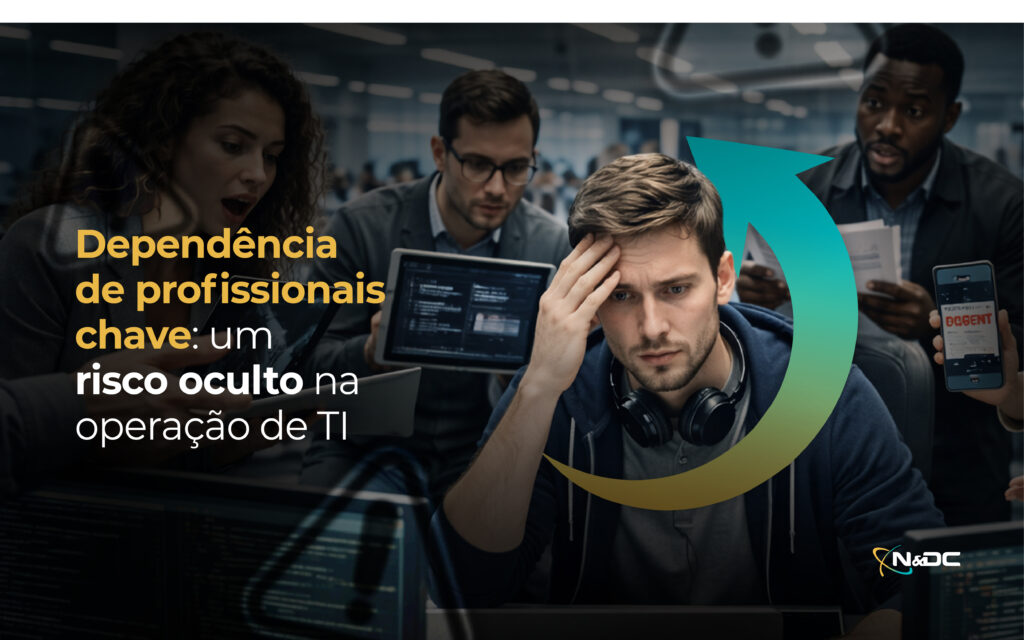
 In today’s corporate environment, where technology powers virtually every operation, there is a vulnerability that rarely appears in governance reports or monitoring dashboards: the excessive reliance on specific professionals.
Complex systems, critical integrations between platforms, customized infrastructure configurations; often, the operational knowledge of these elements is concentrated in just a few individuals.
While availability metrics show satisfactory numbers, the operation rests on a fragile foundation: the memory and constant presence of specific individuals.
How a Dependency Scenario Takes Shape
How does this situation arise? The formation of this scenario is gradual and often imperceptible to leadership. It begins with a professional who resolves a complex crisis.
The solution is implemented, the system returns to normal, but the full documentation of the procedure is postponed for later — a “later” that rarely materializes. Over time, that employee becomes the sole holder of knowledge about a given system or process.
In integration projects, for example, it is common to encounter architectures whose particularities are fully understood only by those who originally implemented them.
When that professional is absent—whether due to time off, health matters, or a career transition—the operation faces disruptions that seem inexplicable.
Incidents that were once resolved quickly begin to require hours or even days of analysis.
Data That Confirms the Problem
The data confirms the scale of the issue. A survey conducted with development professionals, available in the annual survey by Stack Overflow., indicates that 68% of developers admit to holding critical, undocumented knowledge within their organizations.
The study reveals a scenario in which valuable technical knowledge often resides solely in individual experience, rather than in organizational repositories.
These figures highlight a common practice that puts operational continuity at risk.
The Consequences for the Business
Companies operating under this model face risks to operational continuity, where the departure of a key professional can bring essential processes to a standstill for extended periods.
The difficulty of innovation also becomes evident, as systems that depend on concentrated knowledge turn into structures the organization hesitates to modify.
Significant indirect costs also arise from the need to retain these professionals at any cost, in addition to limitations on operational scalability, which becomes constrained by the capacity of these few specialists.
The result is a false sense of stability: everything works—until the indispensable person is no longer available.
Risk Mitigation Strategies
Companies that recognize this risk and take a proactive approach implement several fundamental practices. The first step involves mapping critical dependencies, clearly identifying where knowledge concentration points exist.
Next, structured mentoring and shadowing programs allow knowledge to flow systematically rather than sporadically.
Documentation must become an integral part of the systems’ lifecycle, where every implementation, modification, or fix includes updating the corresponding knowledge base.
At the same time, an organizational culture is cultivated that encourages and recognizes knowledge sharing, demonstrating to professionals that their value increases when they multiply their expertise, not when they restrict it.
The Leadership role
The solution to this problem begins at the strategic level. Information technology leaders must recognize that knowledge resilience is just as important as technical infrastructure resilience.
This requires the deliberate allocation of resources, time, budget, and personnel specifically dedicated to knowledge management.
Implementing metrics that monitor the distribution of technical knowledge, along with promoting a culture that values both collective sharing and individual expertise, are decisive steps on this journey.
The Role of a Specialized Partnership
On this path to maturity, having the strategic support of N&DC is the differentiator that turns vulnerabilities into operational resilience.
As specialists in comprehensive technology solutions and end-to-end IT services, N&DC brings the expertise needed, especially in critical environments leveraging Cisco technology, to map processes and ensure that technical knowledge becomes an organizational asset, not an individual one.
Our focus is on providing tailored solutions that eliminate human bottlenecks and professionalize the management of your infrastructure, ensuring that technology always serves as a driver of safe, continuous business growth.
Don’t leave your business continuity to chance or isolated knowledge.
Do you want to learn how we can safeguard your operations and build a more resilient IT environment?
Discover our customized solutions and see how N&DC can support your digital transformation journey with security and efficiency.